Category | AI And ML
Last Updated On 25/09/2026
AI engineering is no longer limited to building models in a research lab. Today, organizations need professionals who can turn AI capabilities into working systems that solve real business problems.
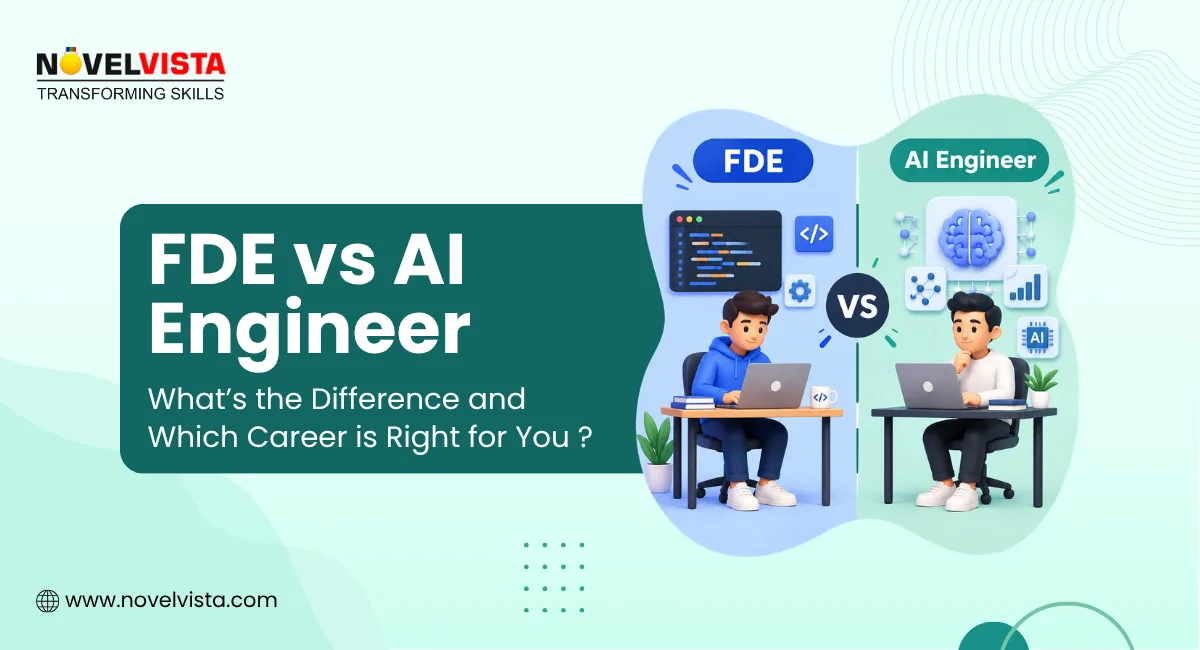
But this shift has created an important career question: What is the difference between an FDE and an AI Engineer?
Both roles work with modern AI technologies. Both require strong software engineering skills. Both may build RAG pipelines, AI agents, APIs, evaluation systems, and production applications.
So, FDE vs AI Engineer are they actually different careers?
The short answer is yes.
An AI Engineer typically focuses on building and improving AI capabilities within a product or technology organization. A Forward Deployed Engineer (FDE) takes those capabilities into a customer's environment and makes them work with real data, legacy systems, security restrictions, and business workflows.
This distinction matters because enterprise AI adoption has exposed a major problem: building an impressive AI demo is not the same as delivering measurable business value. The supplied source identifies a 95% failure rate for enterprise AI projects, attributing the post-deployment value gap largely to workflow alignment and operational complexity.
That is where the FDE role becomes particularly important.
At the highest level, both professionals are trying to make AI useful.
The difference is where they work, whom they work with, and what they ultimately own.
| Role | AI Engineer | Forward Deployed Engineer |
| Primary environment | Internal product/platform | Customer environment |
| Main focus | Building AI capabilities | Deploying AI into real workflows |
| Primary stakeholders | Product and engineering teams | Enterprise customers and technical stakeholders |
| Data | Usually structured/internal | Often fragmented, legacy, or customer-specific |
| Success metric | Model/system performance | Business outcome and adoption |
| Technical challenge | Scalability and reliability | Integration, security, deployment and adoption |
An AI Engineer's output may be a production AI feature, model pipeline, or internal AI service. An FDE's output is more often a working system deployed for a specific customer and producing a measurable operational result.

An AI Engineer focuses on building, refining, deploying, and operating AI systems.
The exact responsibilities vary depending on whether the engineer specializes in generative AI, agentic AI, AI infrastructure, LLMOps, or application development.
Typical responsibilities include:
For example, an AI Engineer might develop a RAG-based enterprise search application, create an automated evaluation pipeline, or build an agent capable of calling business APIs.
Their work is generally optimized for repeatability and product-wide scalability rather than one customer's unique environment. The source describes AI Engineers as being measured through model benchmarks, system availability, and feature performance.
A Forward Deployed Engineer operates much closer to the customer.
Instead of simply asking, "Can we build this AI feature?", an FDE asks:
"Can we make this work inside the customer's actual environment?"
That question can introduce a completely different set of challenges.
The customer may have:
An FDE connects AI engineering with customer deployment and business execution.
Their work typically covers three stages:
The critical difference in FDE vs AI Engineer is therefore ownership.
An AI Engineer may own whether the technology works.
An FDE must also own whether the technology works for the customer.
Despite their differences, FDEs and AI Engineers share a substantial technical foundation.
Both roles benefit from strong knowledge of:
The source specifically identifies production Python, cloud-native development, RAG, agentic workflows, evaluation techniques, and practical system design as common technical foundations.
So, moving from AI Engineer to FDE does not necessarily mean starting your technical career again.
Instead, it means adding a customer-facing deployment layer to your existing engineering capabilities.
This is one of the clearest differences in FDE vs AI Engineer.
AI Engineers generally serve internal product teams or the users of a standardized product.
FDEs work directly with named enterprise customers and their stakeholders, which can include CTOs, CISOs, engineering leaders, and domain experts.
That means an FDE needs to understand not only technology but also stakeholder communication, requirements discovery, and business priorities.
An AI Engineer may ask:
"How do we make this architecture scalable?"
An FDE may ask:
"How do we make this architecture work with this customer's firewall, legacy database, security policy, and data?"
This is why FDE work often involves what can be called technical archaeology investigating messy systems, old data structures, scanned documents, access-control lists, and infrastructure constraints before designing the solution.
AI Engineers typically sit within product engineering, R&D, AI platform, or ML teams.
FDEs are more commonly organized around deployment pods, field engineering teams, or dedicated FDE organizations.
This organizational difference also affects how success is measured.
Dimension | AI Engineer | FDE |
Primary output | AI features and services | Production customer deployments |
Customer | Internal teams/general users | Specific enterprise customers |
Technology environment | Standardized stack | Customer-specific stack |
Data | Relatively controlled | Often messy and fragmented |
Ownership | Technical/product performance | Technical + business outcome |
Feedback | Product roadmap | Direct customer feedback to R&D |
Success | System performance and adoption | Business impact and customer adoption |
The comparison highlights why FDE vs AI Engineer is not simply a difference in job title. The two roles apply similar engineering foundations to fundamentally different operating environments.
Career Level | AI Engineer – India | FDE – India | FDE – Global/US |
Entry Level | ₹6–15 LPA | ₹18–28 LPA | $140K–$220K |
Mid Level | ₹15–35 LPA | ₹30–55 LPA | $250K–$510K |
Senior Level | ₹35–80+ LPA | ₹50–90+ LPA | $340K–$785K |
Staff / Principal | ₹60 LPA–₹1 Cr+ | ₹90 LPA+ | $750K–$1.2M+ |
AI Engineer salaries vary significantly by specialization, company, and experience; senior GenAI roles can reach ₹80 LPA or more in India. FDE compensation can be considerably higher at frontier AI companies because the role combines engineering, deployment, and customer-facing execution.
The interview process is another major difference in FDE vs AI Engineer careers.
An AI Engineer interview typically emphasizes:
FDE interviews add another dimension: customer execution.
A typical FDE process may include a decomposition exercise where the candidate receives an ambiguous business problem and must ask discovery questions, identify constraints, and define a practical first version. Candidates may also face live-build exercises and customer role-play involving security objections or AI failures.
In other words, FDE hiring tests:
Can you build it?
But also:
Can you figure out what should be built, explain it to the customer, deploy it, and handle what goes wrong?
Your existing experience can provide a strong starting point for either path.
Software Engineers: Backend and full-stack developers already have much of the production coding foundation required. Adding RAG, agents, evaluation, and customer discovery can create a strong pathway into FDE roles.
DevOps and Platform Engineers: Experience with infrastructure, cloud, deployment, networking, and security can translate particularly well into enterprise AI deployment and FDE work.
Solutions Architects and Consultants: These professionals often have strong stakeholder-management skills but may need deeper hands-on experience with AI engineering, APIs, RAG, tool calling, and evaluation systems.
This makes the FDE vs AI Engineer decision less about choosing the "better" career and more about choosing the environment where your strengths are most valuable.
If you want to become an AI Engineer, focus on building technical depth in:
If your goal is to become an FDE, add another layer.
Learn how to:
The supplied material describes this additional FDE capability as closing the "30% delta" between strong software engineering and customer-facing deployment expertise.

For professionals evaluating FDE vs AI Engineer as a career choice, the most valuable preparation is not purely theoretical.
You need a combination of production software engineering, applied AI, enterprise deployment, and customer-facing problem solving.
NovelVista's Forward Deployed Engineer AI training is designed around this intersection, helping professionals build the technical and practical capabilities required to move AI from prototype to production.
The focus is particularly relevant for engineers who already understand software development but want to strengthen skills in areas such as RAG, agentic AI, AI evaluation, enterprise deployment, technical discovery, and stakeholder management.
The goal is simple: prepare professionals not just to build AI systems, but to make those systems work in the environments where businesses actually operate.
The FDE vs AI Engineer decision ultimately comes down to the type of engineering problems you want to solve.
If you enjoy building AI products, optimizing models, designing scalable architectures, and working primarily within an engineering organization, an AI Engineer path may be the natural fit.
If you enjoy ambiguous problems, direct customer interaction, rapid prototyping, enterprise infrastructure, messy data, and taking responsibility for whether an AI solution delivers real-world value, Forward Deployed Engineering may be the stronger career path.
The future of enterprise AI will need both.
AI Engineers build the capabilities.
FDEs make those capabilities work where it matters most, in real business environments.

An AI Engineer primarily builds AI products and systems, while an FDE deploys and adapts AI solutions within customer environments. FDEs also take greater responsibility for customer outcomes.
Yes. AI Engineers already have many of the technical skills required for FDE roles. They typically need to add customer discovery, enterprise deployment, and stakeholder-management skills.
Yes. A strong FDE needs practical knowledge of RAG, AI agents, APIs, evaluation, cloud infrastructure, and production software engineering.
Neither role is universally better. AI Engineering suits professionals focused on building AI products, while FDE suits engineers who enjoy deployment, customers, and solving complex real-world problems.
Absolutely. Software engineering provides a strong foundation for FDE careers, particularly when combined with applied AI, enterprise security, technical discovery, and customer-facing skills.
Author Details

Confused About Certification?
Get Free Consultation Call
Stay ahead of the curve by tapping into the latest emerging trends and transforming your subscription into a powerful resource. Maximize every feature, unlock exclusive benefits, and ensure you're always one step ahead in your journey to success.